Note from Nancy...
I'm sure that many of you can relate, as I tell you about a couple so-called bad days. Please don't think that these experiences are because we live in Cuenca...could happen anywhere. You know...those little aggravating moments. Nothing life-threatening, nothing earth-shattering, just annoying!
On Friday the 13th, all heck broke loose in the kitchen. Everything I touched seemed to break! The faucet came off in my hands, the refrig and sink were leaking all over the floor, the landline had no dialtone, the computer was all screwed up, the knobs on the stove came off...again, the dishwasher refused to turn on...you get the picture. It was not pretty.
As we mopped the floor and unloaded the dishwasher to wash by hand (and I whined to Rich), I had to remember that we'd had those kind of days at the Ranch in Oregon, too. There were the days the high winds down'ed some trees and knocked out the power. No power also meant no water. Those were probably the same no-good days Boots the kitty insisted on bringing me 'gifts'...baby birds, lizards, mice...all needing my attention. And, probably the same days the car battery died and the deer ate my tulips and my allergies turned up a notch and I had to rip out knitting mistakes and Rich was out of town...
Bad days can happen anywhere.
All of these bad moments, wherever you are, do eventually turn to good! Happy to report, all is 'getting' well in the kitchen! New, fancy faucet installed, refrig is working just fine (must have been the celery blocking something) dialtone miraculously returned, computer is back (not sure what that was), new dishwasher is on order and the knobs on the stove are back on. A good day today in the kitchen and I'm making soup!
And, all those so-called bad moments did turn to good at the Ranch, too. I'm remembering those days that seemed to be all good, canceling out those little annoying moments, wherever we were.
Everything looks better with sunshine and friends. Just like here in Ecuador, just like anywhere.
So, here's to sunshine and the good times! Here's to friends!
Wednesday, May 18, 2011


Monday, May 16, 2011
Downtown
These are pictures from some of our recent walks in the downtown area.
 Love the red legs!
 More street art with nice messages of peace and family.

Cuenca still has pay phones.


 Art around a renovation project of an old church, Todos Santos, on Av Calle Larga.
 Claro is the new name for the old Porta. (cell phone company).
 You can see how popular jeans are here.
 We like this angel on a school building.
 This young lady is carrying a whipped, sweet treat for sale. We hear it's made with raw eggs. The kids love it.
 A line of booths selling Mother's Day gifts outside the New Cathedral.
 A street doggie finding a meal.
 The beginnings of a garden at the high school on Av Solano.
We're looking forward to walking with the Watsons soon.
Safe travels to Chuck and Nancy, who are headed home to Cuenca, yay! We've missed you guys!


Cuenca still has pay phones.


We're looking forward to walking with the Watsons soon.
Safe travels to Chuck and Nancy, who are headed home to Cuenca, yay! We've missed you guys!
Sunday, May 15, 2011
Mother's Day Walk -- Construction, Flowers and Cakes
We took a walk in the neighborhood to see what we could see on Mother's Day. We figured we'd at least have a cup of coffee at the Oro Verde Hotel, stretch our legs a bit and get out for awhile. Always good to take a walk before the rains in the afternoons.
 The new apt building, called River View, on Av Ordonez Lasso is progressing well...
Here's a few shots for those interested in building techniques here.

 It's located right next door to another apt building, called the Montecarlo.

 You can see the rebar for the new building is right up to the property line.
 We passed a flower shop with beautiful arrangements.

 Special Mom Day cakes at the hotel!

We hope all Moms had fun on their special day!

Here's a few shots for those interested in building techniques here.


We hope all Moms had fun on their special day!
Wednesday, May 11, 2011
Up, Down and Sideways
(Note from Nancy, responding to some questions and comments we've received off-blog.)
We had to laugh the other day when some expats commented they were going to start a new blog...all the ugly, the downside, of Cuenca. It was a light moment...' Ack! Too many gringos are coming! Someone, please, tell the folks that this isn't Paradise! Maybe the crowds of new gringos will stay home!'
As we say, it was all a funny moment, with a few barbs. It was easy for some to say there are now too many gringos...the gringo invasion!...since we're already here....
Most expat and traveling folks are cheerful and positive and hopeful and sometimes funny.
Yes, it's true, Cuenca is mostly Paradise to some, including us, but there are the not-so-perfect moments. Thankfully, those moments are few.
In the beginning of the visit or move here, you could experience more of the yucky, culture-shock side, as you learn and adjust. Those frustrating moments of getting stuff done, finding stuff, getting lost all the time, learning your Spanish, finding new friends....or getting sick. The waves of homesickness, and missing all good things US American, can be more painful than a poke in the eye... And, O Lordy, the noise of the City! But, if you stay and adjust, those yucky moments will eventually pass, at least enough so you are not totally paralysed and constantly unhappy. You will read on other blogs that most who stay here eventually just 'get with the program' and settle in just fine.
Loud whining and complaining in public will do no one any good. We hear the loud complaints from mostly un-adjusted, new gringos in shops, markets, restaurants, parks...better to do your loud complaining in private, don't you think? You can rant on your blog (readers can choose to read or not) or through emails or Skype with your friends and family. You can whine privately with your close friends. Those who have been here awhile have mostly adjusted to the more quiet, civilized way of life. That public, ugly, in-your-face, loud, super US American-ness, seems so foreign to us now and we know that screaming in a worker's face will just raise everyone's blood pressure and get nothing good done. We suspect Ecuadorians don't appreciate it either.
Paradise can have a Downside, or even a 'Sideways' side. As you adjust and get your bearings, you may even go Down, Up, Down, Up, then Sideways...you may even get dizzy going around and around, as you go through the range of emotions and perspectives! Sometimes I still do, as I twirl through it all.
For instance:
You're trying like the dickens to find the perfect place to live....AGAIN!
Up: Lots of choices!
Down: The place you really want to rent or buy is too expensive, or there are barking dogs next door, or you'd be on the bus route with too much diesel fumes... or out in no-darn-where.
Sideways: You adjust the budget, or negotiate a better price. You get some earplugs, or keep looking. Or you decide to try out the new place and move later (again!) if you need to. You do your homework and learn the bus schedule, or plan to budget for longer taxi rides or consider buying a car.
Many newcomers move several times before they are happy. It's easier to rent at first as you learn the neighborhoods.
Another example:
Down: It's raining ... again...
Up: When it rains here, it means we have power...no drought...and the rivers are full and the grass is green. If you have a garden, it also means you don't have to fight with the hose to water the plants. It's sure nice to have this old City washed down nearly every afternoon.
Sideways: Find your umbrella and go out anyway. Or, get on those sweats, make some popcorn and watch a movie. You can't change the weather!
Or:
Down: The water in your apt suddenly goes off, with no warning. For hours.
Up: Well, maybe the folks are doing the maintenance on the system to keep the water clean. Maybe now is the time to practice your very best Spanish and ask the guards or the building office folks about it.
Sideways: Shoot, now is the time to just go out, all grubby, with your dirty hair shoved up in a hat, and plan to shower, mop those dirty floors and catch up on laundry later. Or, read all day or watch movies until the water comes back on. Gives you a great excuse not to clean! There's always tomorrow for those chores.
(Note to us -- Remember to buy bottled water for the next time so you can at least brush your teeth and make a cup of tea and remember to take your dictionary when you go to speak with the guards.
And, never take running water for granted! Even in a modern highrise.)
We've also heard more heated discussions on politics....US politics and Ecuadorian politics both. Some topics are just plain divisive. Many folks don't even go there as most are no win situations.
We've heard these comments just in the last few weeks:
.'The US government is MAKING us move to a 3rd world country', (which is debatable, that 3rd world comment) . We've heard 'We BLAME the US politicians for breaking up our family, being sick, raising taxes, pushing jobs overseas, losing our 401K'...you name it, and the negative comments go on and on and on...
The US is our birth country, too, and I am saddened that so many US citizens find themselves in such unhappy conditions. There are good reasons for it. But, you don't have to feel and act like a victim. You've got choices...
Remember, you can vote as a US citizen, even if you live in Ecuador. Try to vote the politicians out if you don't like the direction the US is going in...or vote with your feet, as many here have. We agree that parts of the US are broken. But, we also believe no one is forcing you to visit or move here. There are perfectly other good places to go (or not). You may have more choices on how you'd like to live. Do your research and find the life-style and location that suits you. We're grateful for having the opportunity to travel and move here, not everyone can.
Our opinion about Ecuadorian/South American politics? We're still learning. We do know that citizens here get involved, voice their opinions and protest loudly if they feel the politicians are not listening to them. Voting here is mandatory for all citizens, with few exceptions. The politicians seem to listen to the people and are voted out if they don't pay attention to what the people want. As guests in this Country, we listen and learn and cheer the people on. Regardless of what you may have been told, Ecuador is an active democracy. Its economy is a robust, free enterprise system. It's not perfect, but it's fascinating to watch.
The 2nd heated topic lately has been about local food.
Some new arrivals only want to eat food they are used to back in the States. There are KFC and Burger King here, but you'll pay more than for the typical food. Typical food is generally more healthy for you than US fast food. Local food plates usually come with fresh fruit juice and vegetables. The set lunch menu of the day is about $2-$3, a bargain for alot of food! We tend to eat around the stuff we don't like (like the usual white rice served on each plate), and we still can't eat it all.
You will pay more for those exported items, like Jif peanut butter, one of our favorites, too, when we can find it. Shop and ask around...you might just find a good substitution made locally.
You can also try out the restaurants with more 'gourmet' food: Italian, Greek, French, Cuban, Colombian, Peruvian, Mexican, Asado - Argentina style, Vegetarian, and the list goes on. Lots of good choices.
We weren't sure we liked the local food at first either. Before moving here, we just assumed the food in Ecuador was hot and spicy, not true. Through trial and error, we've found that some of the local food is quite good. The produce is awesome! We love the soups and the ice cream!
If you'd like to know what you're eating and buying, learn some Restaurant Spanish and Shopping Spanish. Some of the first Spanish words I learned was 'chivo' and 'cuy'. (goat and guinea pig; I prefer to eat neither.) You can always check your dictionary before ordering so you're not surprised with mystery food.
That 'hamburger' you order in the restaurants may not be what you're expecting...could be meatless, with lentils or grains or rice instead, or who knows. But, the burger could be fabulous, like those at CA Kitchen or the Inca Lounge (being US expats, the owners really know how to build a burger-US style!).
Just the other day, we heard some gringos 'horrified' that they had heard some folks eat horse meat here. Well, maybe they do. But, that doesn't mean you need to eat it! If you are unhappy with the prospects of eating 'pets' (including cuy), then you can choose not to buy and eat it. I pass on eating 'pets', but I don't expect everyone else to. Just pass on that ground 'beef' in the market if you don't want to eat horse, if the rumors upset you. Labeling the meat as 'beef' may not be truthful, but we're not in the US anymore. By the way, folks eat horses in France, too; it's not just a South American thing.
http://en.wikipedia.org/wiki/Horse_meat
So -- enjoy those Up moments and minimize the Down ones. Go 'Sideways' , or 'Go Long' as our friend Guy used to say.
We think it's easier to be in Paradise if you do.
Peace.
PS -- We've now lived in Cuenca for 800 days! We're still loving it here!
Friday, May 6, 2011
On a Clear Day...

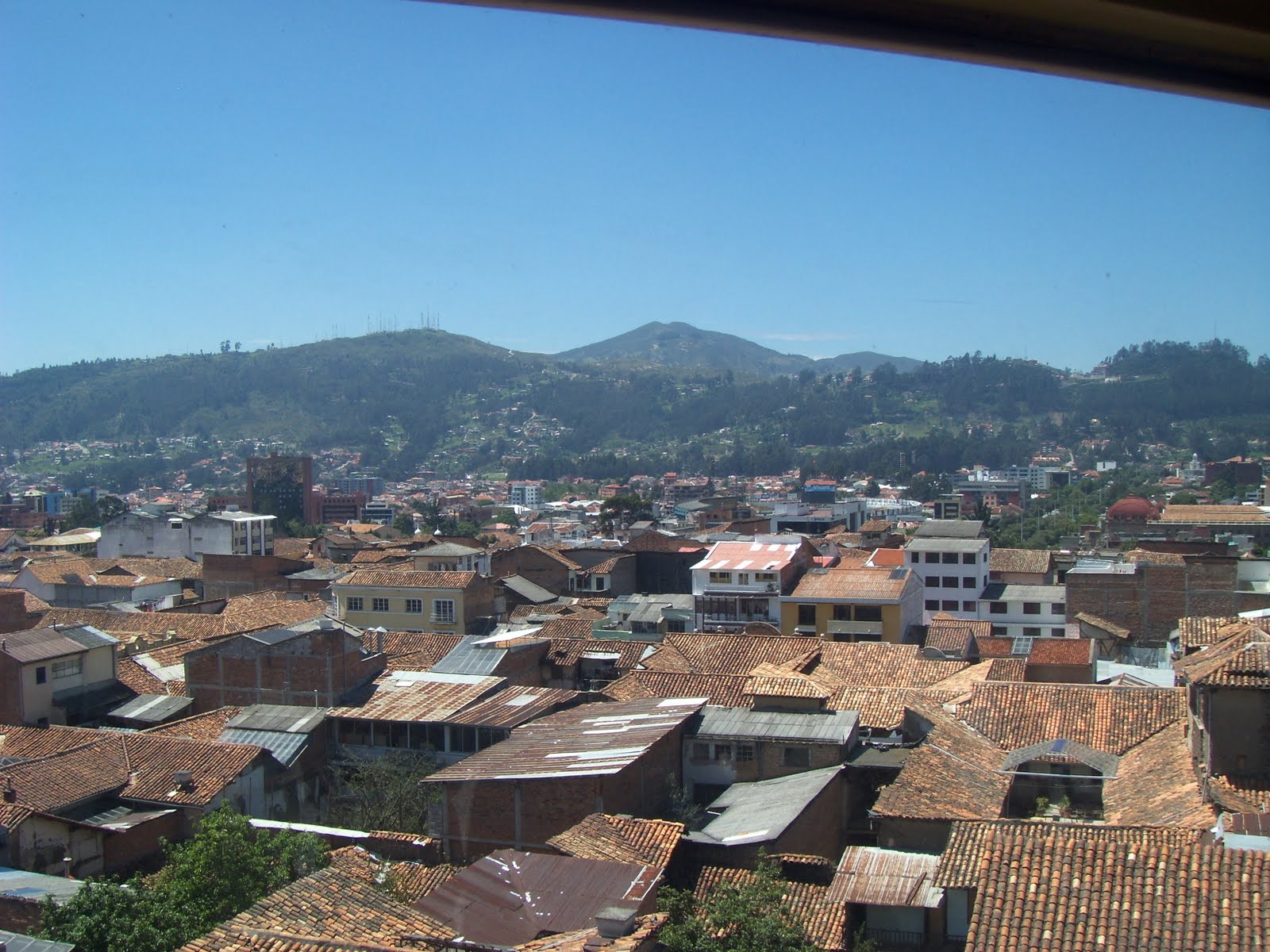
Rich took these pictures one spectacular day here in Cuenca.




Gringos on the Bus -- Another Story by Magdalena
This is the 3rd blog featuring our friend Madeleen's experiences here in Cuenca. You can read her other contributions by searching this blog. We appreciate her permission to share another of her stories with you.
Hang on for the ride!
-----------------------------------------
GRINGOS ON THE BUS
Since we do not have a car and live at least 15 minutes away from Cuenca by car in Challuabamba, we need to rely on the Ecuadorian bus system, which will get you just about anywhere, but not always in the same or predictable fashion. To catch a bus, we have to hail one on the Autopista, a highway that connects Cuenca to Azogues, a town about 30 kilometers North East of Cuenca. Depending on what bus you take and at what time, it takes approximately 30 minutes to get from Challuabamba to Cuenca.
There is no such thing as a bus stop sign on the Autopista, but it is understood that “the bus stop” is at a convenient place where the bus driver can see you and put the brakes on hard to pick you up or at a spot that has been “designated” by the local people. That means we have to look where other people are waiting. If no one is waiting, we take our chances.
To hail the bus down, you hold your arm out vertically, not all the way up in the air as we do in the U.S. However, it is not guaranteed that the bus will stop for your signal as we have experienced. It particularly hurts when the bus only runs every 40 to 50 minutes and doesn't bother to stop. Cursing the bus driver only momentarily makes you feel better. The day a city bus driver did not stop for us, we had to backtrack to the Autopista to catch a different kind of bus. We were picked up by a Provincial bus, full of indigenous folks resting or sleeping on reclining chairs which did not straighten up anymore from overuse. A sour smell of unwashed masses pervaded the bus making our nostrils itch.
There are at least two choices of buses for us; one is the above mentioned Provincial Azogues-Cuenca bus and the other is the city bus or bus urbano. The Azogues-Cuenca bus is more comfortable than the city bus. The fair is 30 cents per person, or sometimes 40 cents or even 50 cents per person. If we are going back to Challuabamba from Cuenca we catch this same bus at the bus terminal where we have to go through a turn stile and pay 10 cents a person more. Why is beyond us as well as the reason why the bus ride costs more or less from one day to the next. Since we are usually the only gringos, paranoia creeps in wondering if these prices only vary for us. Best to pay whatever they want and call it good. At least until we can confidently say in Spanish go to hell on the horse you rode in on.
The Azogues bus has a TV screen mounted in front of the bus, right behind the driver, however it has never been on while we were on the bus and from the dirt on the screen I doubt it is ever on. Instead, next to it, there is a religious image one can stare at or gain some confidence from: a Maria in her blue robe blessing the passengers or a pieta-type Jesus Christ hanging his head down with the caption: Solo Dios Sabe Mi Destino (only God knows my destiny). The Ecuadorians have obviously more faith in God than we do. In our opinion, the slogan should be” Only the Driver Knows My Destiny“. No one else seems to share this sentiment with us and perhaps these bus matters are best left up to the divine rather than to our lack of faith. We hope, however, that the passengers are praying vehemently to God, when the driver does not turn the windshield wipers on until it is nearly impossible to see through the giant raindrops covering the windshield.
The Azogues bus has some good features: lots of blue and white fringes and tassels hang from the windows as well as over the windshield with the addition of various mascots such as a little bear, a bird, a baby shoe or rosary swinging back and forth in front of the driver and of course the usual loud music. The ride is quite speedy and comfortable, except for when you are sitting way in the back of the bus. We ended up back there one day, attempting to look at the bus schedule for a connecting bus. Every time the bus hit the slightest bump or made a turn, our butts lifted off the seat as if we were riding a wild horse. Trying to follow the fine red and blue lines of the bus guide was impossible.
The city bus has several advantages over the Provincial bus in that it gets you straight into Cuenca center, it is cheaper, only 25 cents, and the price does not change coming or going. But it does take longer, since it goes through more neighborhoods and makes more stops. Some of the younger passengers have student cards and adults have monthly bus passes. Every time a quarter is dropped in the slot of the money box, there will be a mechanical sound “dadong” that confirms the receipt of the money. Otherwise, the machine will say : “Estudiante” or” Gracias” whenever someone boards the bus. After a while it sounds like a musical score: Dadong, Gracias, Gracias, Estudiante, Estudiante, Estudiante, Gracias, Dadong.
And once in a while, the candy man will entertain the bus passengers. A young man boards the bus with a box of chocolate bars and eloquently addresses the crowd gesturing towards the heart holding up two chocolate bars. He then proceeds to hand out two bars to each passenger on the bus. Back at the front of the bus, he continues his spiel and guilt trips the passengers into buying the two bars for 50 centavos. He walks through the bus for a second time and collects either the two bars or 50 cents. What a deal.
One afternoon after my writers group and after doing a few errands, we were later than usual returning home. We decided to take the city bus, so we would not have to change to another bus at the bus terminal. We walked down to Calle Larga to catch the bus, but it turned out we were waiting for the bus in the wrong spot; buses do not necessarily take the same route coming and going, so we had to hike close to 10 blocks uptown to Calle Pio Bravo for our bus number 9. By the time we got there at 5 p.m., hot and sweaty, a mass of working people were waiting for the same bus. A snotty little kid with a blue balloon kept swatting us as we waited. Irritated and too tired to say anything, I stayed out of his way as much as I could, a close eye on his blue balloon. The kid's young mother told the boy and his slightly older brother to sit next to me on the window sill while she went to buy some avocadoes and some candy. Still swatting the balloon, it all of a sudden lost air and became a sloppy piece of rubber. I was delighted. The little kid tried to blow it back up, but couldn't and then insisted I blow it up. No way. I told him I did not know how, but then his older brother tried to show me how to do it.
Just in time the bus showed up and we piled in. By now the bus was already full, no seats to be had, standing room only. As usual, we were the only gringos on the bus. If we had been in Europe, the younger people would have gotten up for us grey haired over 60 folks. I started to feel resentful looking at the many young men occupying many of the seats, but then reminded myself they probably worked really hard and could not wait to have a seat and a snooze. Indeed, people of all ages were sleeping as the bus lurched forward, racing when traffic allowed and coming to sudden stops when someone wanted to get off.
No one seemed to care or notice, when a puppy followed an indigenous couple crossing the street in front of the bus. The bus sped up, the puppy changed its mind in the middle of the street, and turned back where it came from. The women on the street were yelling at the foolish animal. My stomach did a rapid double time, sure the puppy was going to be dead meat. The bus barely missed it. It took me a while to catch my breath, and settle down my intestines. I did not dare consider that the bus driver had actually aimed for the dog.
At Challuabamba the bus emptied out. I watched the older men and women walk home loaded with packages knowing they still had to cook and take care of the family after a hard day of work. I felt for them, but vowed I was not going to take the commuter bus home again if I could help it. After all it was their bus, not mine.
Telling a Cuencano about living in Challuabamba, he asked if we had a car. No, we take the bus, we proudly said. His eyebrows went way up and when we told him about our variable fares and buses passing us by, he shrugged his shoulders and laughed. “They probably think you are “crazy gringos”. We laughed too, but we didn't feel so great. We hailed a taxi to Challuabamba after that conversation, which cost us merely $5 that day, although we had paid $6 or even $8 for the same ride at other times. The Cuencano gave us the following bit of advice: you give the driver the change you know is right and if the driver wants more, you say “pfft”, throw your arm up, not unlike “up yours”, and walk away. Sure, we'll do that.
------------------------------------------------------------------------------------------------------------
Wednesday, May 4, 2011
Busy Sunday -- Workers and the Pope
Last Sunday celebrated 2 events.
May 1 was Workers' Day and it was also a big day to celebrate Pope John Paul II and his steps toward sainthood.
At the flower market we experienced both celebrations of life. Folks were marching for Worker's Day, down the middle of the street. There was also a crowd celebrating the Pope outside the church at the market. Both crowds blended into one, lots of people!
Here are some pictures. First, outside the church.

The umbrellas are the flower market. The poster is on the side of the church.

 Big crowd gathering.
 Crowd control.

You can see the marchers in the background.
 Angels.
Pictures from the March.


You can see a picture of Che on this banner.
Marchers also took this opportunity to protest or support the upcoming ballot issues. Citizens go to the polls May 7. (Voting is mandatory here, with very few exceptions.)


Another interesting Sunday.
May 1 was Workers' Day and it was also a big day to celebrate Pope John Paul II and his steps toward sainthood.
At the flower market we experienced both celebrations of life. Folks were marching for Worker's Day, down the middle of the street. There was also a crowd celebrating the Pope outside the church at the market. Both crowds blended into one, lots of people!
Here are some pictures. First, outside the church.

The umbrellas are the flower market. The poster is on the side of the church.


You can see the marchers in the background.

Pictures from the March.


You can see a picture of Che on this banner.
Marchers also took this opportunity to protest or support the upcoming ballot issues. Citizens go to the polls May 7. (Voting is mandatory here, with very few exceptions.)


Another interesting Sunday.
Subscribe to:
Posts (Atom)